
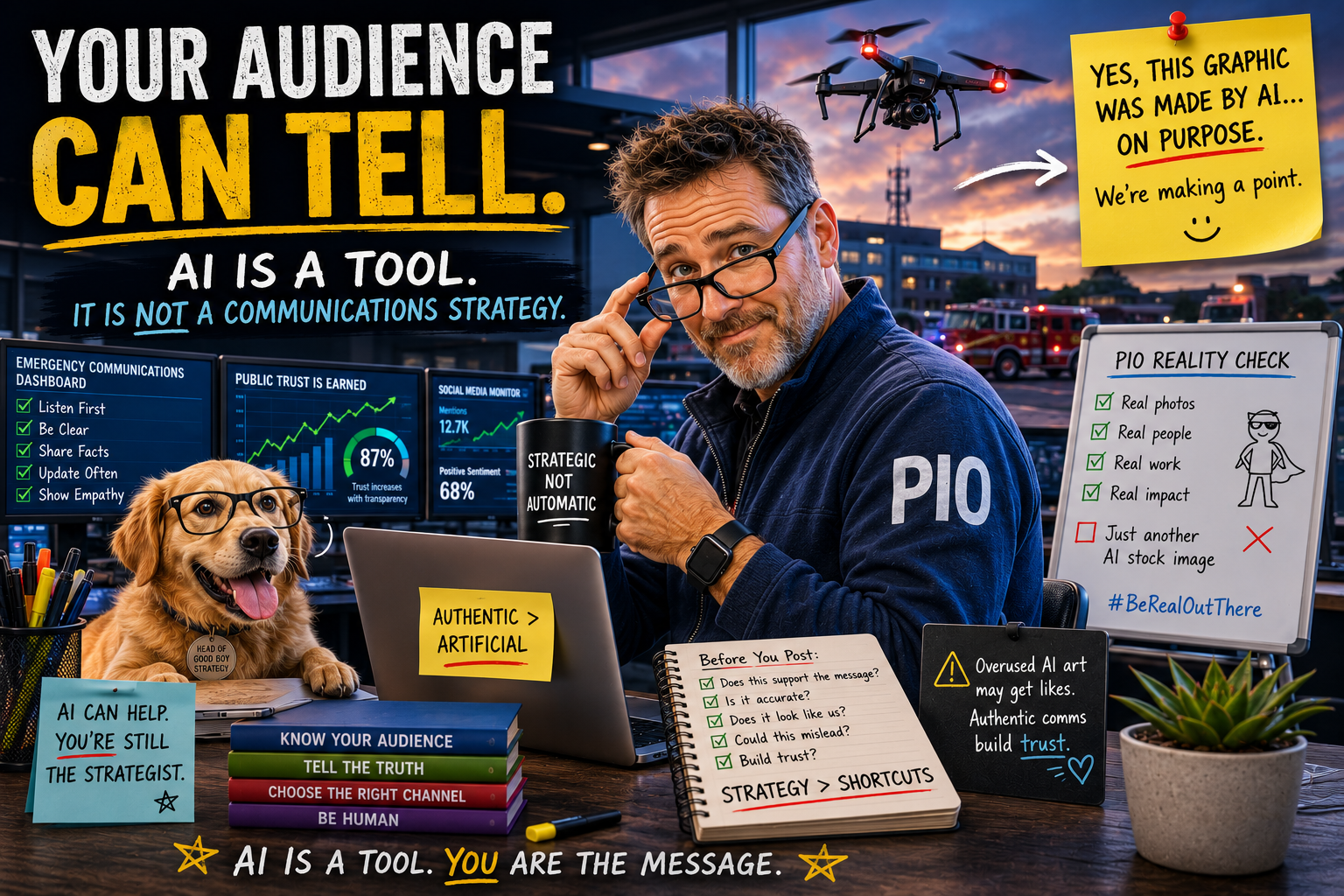
Let’s talk about the strangely perfect elephant in the room.
It has flawless lighting, six fingers, an inspirational slogan and a remarkably diverse group of professionals staring enthusiastically at a holographic dashboard.
It is an AI-generated graphic.
And yes, we can tell.
Easy does not always mean strategic
Artificial intelligence has made it incredibly easy to create images for social media, websites, presentations, newsletters and public information campaigns.
That can be useful, especially for small teams with limited time, limited budgets and no graphic designer on staff.
But easy does not always mean strategic.
More organizations are filling their feeds with AI-generated images. Every announcement has a cinematic backdrop. Every employee looks like a model. Every emergency vehicle is polished beyond recognition. Every community meeting appears to take place inside a futuristic command center.
After a while, the content begins to feel less authentic.
Visuals affect credibility
That matters for public information officers and communicators because credibility is part of the job.
People do not just evaluate the words you publish. They evaluate the entire presentation.
The photo, graphic, headline, tone, timing and context all contribute to whether a message feels trustworthy, relevant and real.
A polished image may attract attention. But if it looks artificial, generic or disconnected from the organization, it may weaken the message instead of strengthening it.
AI is not automatically the problem
AI-generated graphics are not inherently bad.
They can help illustrate an abstract idea, create a conceptual visual, support a training presentation or add personality to a post.
They can also help small organizations produce content they may not otherwise have the time or resources to create.
The problem begins when AI becomes the default instead of a deliberate choice.
When every post uses the same cinematic lighting, artificial people, dramatic emergency vehicles and futuristic screens, the organization begins to lose its own visual identity.
Ask the strategic questions
Before publishing an AI-generated image, ask:
- Does this graphic support the message?
- Does it accurately represent our organization or community?
- Could a real photo, simple branded graphic, chart, quote card or screenshot communicate this more effectively?
- Could the image confuse people about what actually happened?
- Does it look like us?
- Most importantly, does it build trust?
The goal is not to avoid AI. The goal is to make a thoughtful communications decision.
Authentic content already exists
Communicators should be careful not to let convenience replace creativity or judgment.
Your organization already has meaningful visual content.
Your people, facilities, equipment, programs, events, neighborhoods and communities provide authentic material that no image generator can truly replicate.
Sometimes the best image is not the most dramatic one.
It may be a real employee doing the work. A photograph from a community event. A clean graphic using your brand colors. A screenshot showing people exactly where to find information.
Or perhaps no image at all.
The communicator is still responsible
AI can be part of the communications toolbox. It should not become the entire toolbox.
Use it thoughtfully. Review it closely. Be transparent when appropriate. Make sure the final product reflects your organization, your message and your standards.
The responsibility does not belong to the tool. It belongs to the communicator who chooses to publish the content.
Because when every post looks artificially perfect, people may begin to question what else is not real.
And, once again, we can usually tell.